
In Pursuit of Greatness: You’re not Miranda Priestley, you just kinda suck
The aftermath of 'girlboss' feminism, hustle culture and professional amorality
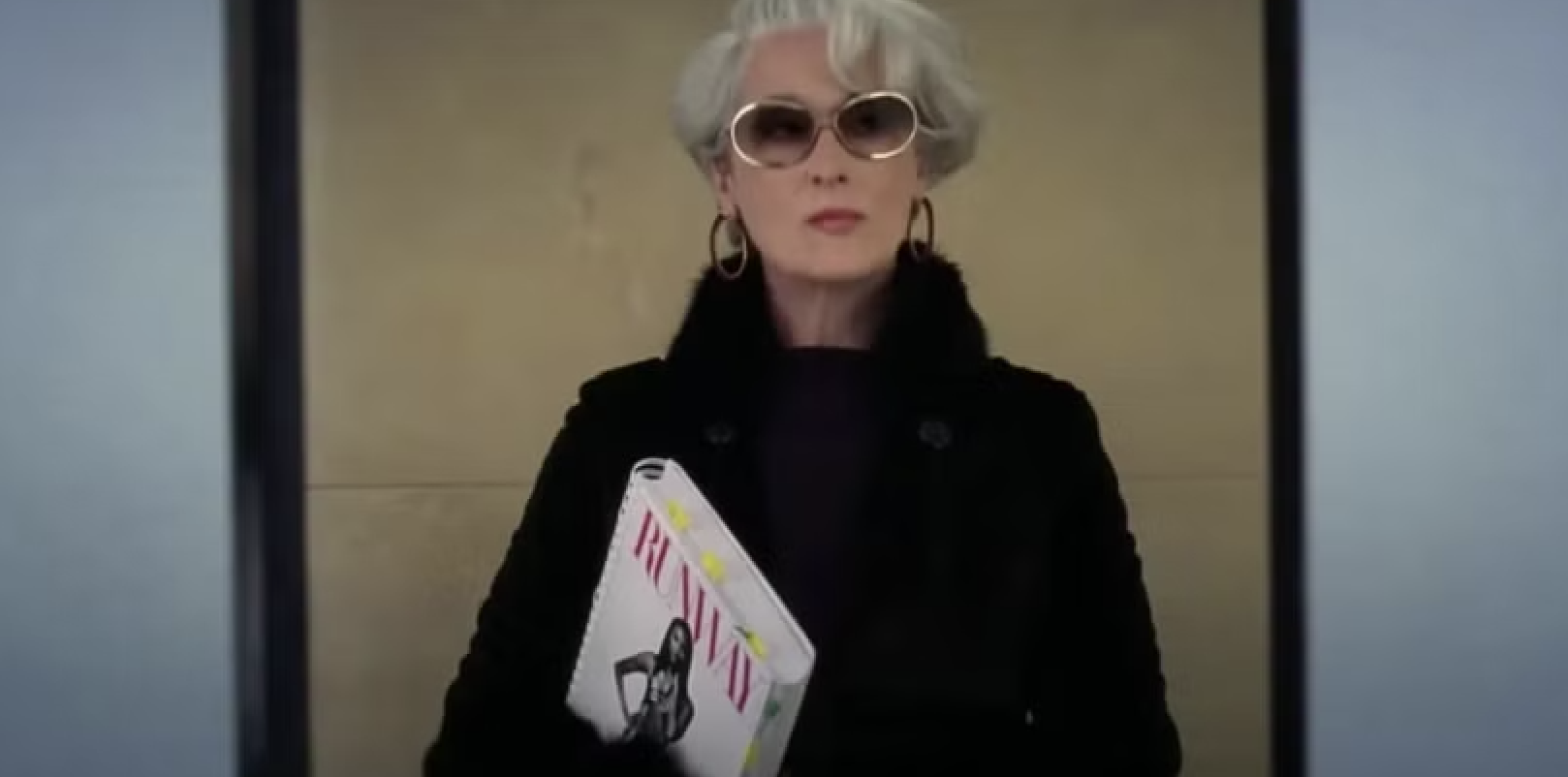
For a moment, I was certain I’d misheard.
I was hunched over the desk in my boss’s office, desperately adjusting the tricky wifi settings so that she could join her next zoom. She was standing over me, arms folded, theatrically rolling her eyes to express her distaste and irritation to onlookers. I was hot and flustered and embarrassed. Frustrated, I muttered under my breath incredulously: “am I dumb?” She responded aloud
“Yes, I’ve often wondered that myself. I recommend going into modelling, because I don’t think you’ll be successful in an office.”
The wifi connected. The meeting joined. I skulked out of the room, humiliated.
At the time, it stung. It was my first job out of college, and I was under the naive impression that such comments in the workplace were relics of the past, appearing only in episodes of Mad Men to triumphantly showcase how far we’ve come. 6 years later, I can confirm that I have never had a boss that hasn’t commented on my appearance - either my clothes, body or (lack of) make up.
This experience certainly isn’t specific to me. One friend confided, for instance, that she felt pressured to start Accutane because she felt that her skin undermined her professional credibility.
Moreover, I’m no beauty queen. Granted, I’m not actively unattractive, but I neither aspire to be professionally beautiful, nor do I have the necessary ingredients. The implication was that as plain as I am, I am even less likely to succeed on intellect alone.
To add insult to injury, I had literally taken the job to impress this woman. She was a powerhouse, an icon, widely touted as the leading gender-focused development scholar in Egypt. I couldn’t believe my luck when I was offered the job. As I packed my bags for Cairo, I entertained egotistical fantasies of being taken under her wing as a mentee. I had lofty, self-serious and unrealistic visions of us strategising between state meetings in Cairene traffic, whispering conspiratorially at diplomatic events and mapping the future of women’s liberation across the Arab World.
Obviously, that didn’t happen.
Instead, publicly deriding my intelligence was one of the least egregious things she did when I worked there. In fact, the job itself seemed specifically designed to be humiliating. She refused to read or write her own emails, or look at her calendar. Indeed, most of my job was printing off correspondence and deciphering her handwriting as I typed out the responses that she insisted on writing by hand, only then to be re-printed and presented to her anew for redrafting.
What’s more, she had total control of my life. Our primary medium of communication was Facebook Messenger, and she would send me commands morning, noon and night. My first task upon waking, every day, was to type out her appointments in a message to her before she took her morning tea - god forbid she opened outlook’s calendar feature. She dictated where I lived and insisted that I was the only person in the office who was absolutely forbidden from remote work so that I would remain shouting-distance from her desk. My boss was so unrelenting in this proximity that she once publicly reprimanded me for eating lunch in the conference room with colleagues. Thereafter, I ate lunch every day alone at my desk. Frequently, she was absent from the office herself, meaning I could have stayed home, yet she refused to be transparent about which days she would not appear. This might have irritated me less were I not living with a colleague, who I would leave every morning eating a leisurely breakfast on our sofa, gearing up for her day of sanctioned remote work.
My boss, knowing that I shared a flat with this colleague, and would invite her over for afternoon tea and dinner without extending me an invitation. I would, likely unsuccessfully, try to suppress my envy as my roommate would breeze home to tell me about how they bonded over dessert and a shared vision of a project I was not allowed to work on (for fear that it would detract from my very important transcription work).
The tension had been building for weeks when I fell ill with a cold that I suspected was actually COVID. The company’s health insurance didn’t cover tests, and I couldn’t afford to pay for one out of pocket on my Egyptian salary. I sent her a message outlining my symptoms and in conversation mentioned that I had likely been exposed over the weekend, as my friend and I were both feeling ill. I suggested staying home, but she didn’t grant the permission to work remotely.
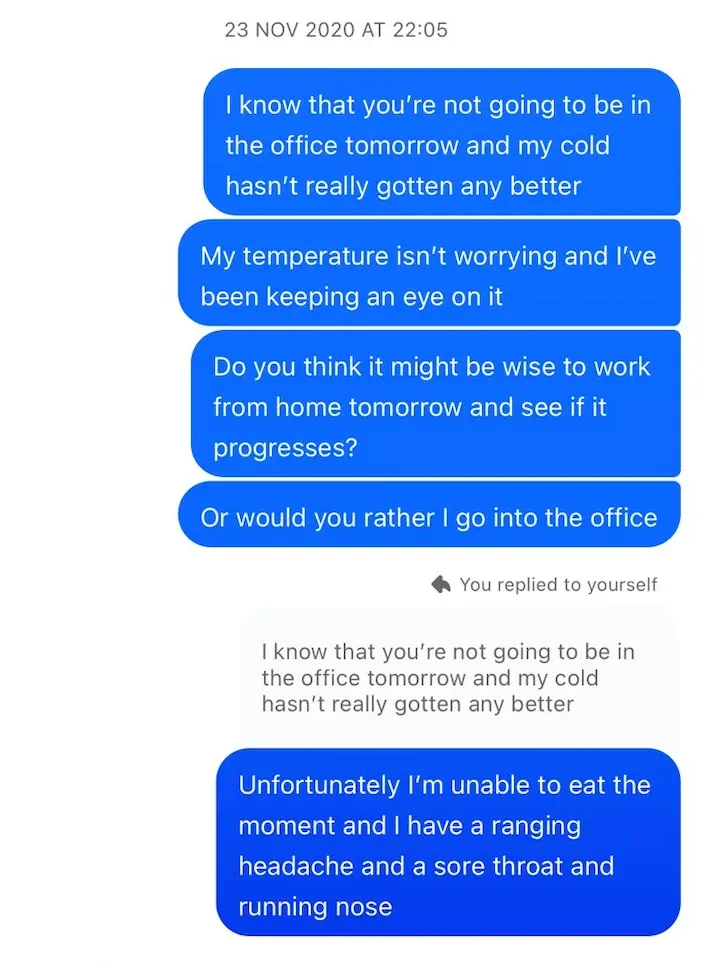
fb messages exchanged
Unsurprisingly, despite wearing a mask and staying home on the days her calendar indicated she was out of office, rumours spread that I was symptomatic. Six days later, my boss sent an unprompted text to the office group chat, implying I had chosen to disregard public health measures by refusing to quarantine or seek treatment at the expense of my colleagues.
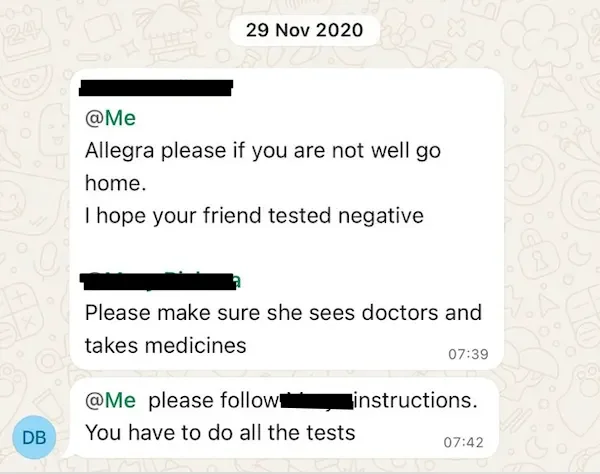
A message sent - out of nowhere - to the office-wide group chat.
I immediately received earnest private messages from others in the office, explaining that it was especially dangerous to ignore quarantine rules in countries such as Egypt, whose healthcare infrastructure was so strained that it was unlikely that anyone taken ill could access quality treatment. I didn’t have the energy to tell them that I was already well aware, and that I had asked to quarantine but was denied.
I handed in my notice shortly afterwards.
It was the right thing for absolutely everybody involved, and so obviously overdue. To be fair, I was far from the perfect employee. To begin with, fastidious organisation, administrative tasks and logistics were never my strongest points. By the end, I was burnt out, disillusioned and, consequently, making frequent silly mistakes. I was finding it hard to take the work seriously, and my resentment was seeping into everyday professional interactions. In the weeks leading up to my resignation, I called my parents every day from my walk home, invariably in floods of tears. I could feel my boss’s patience wearing thin, but I was terrified to admit defeat. Like many people in their early careers, I believed that all the difficulties I was encountering were only proof that I was learning, improving. It seemed to me that the unhappier I was, the more progress I was making. This mistaken belief was unsurprising given that I had just graduated from a university full of students - myself included - who would intentionally lounge around the library entrance smoking endless cigarettes, hoping to snag a passer-by and humble-brag about how exhausted we were from pulling all-nighters to write papers, or how demanding our investment banking internship was. Exhaustion and burnout were badges of honour. It was considered virtuous to give oneself so completely to professional life, to sacrifice oneself for the chance of future success. I believed it too, deeply.
I considered my first post-graduate job a personal failure. I convinced myself that I wasn’t resilient enough to ‘make it,’ in the professional world. I tortured myself with the knowledge that I had received definitive confirmation - from someone who had dedicated their life to the investing in the potential of women, no less - that I was not only not worth her time but also I was, in fact, just kinda dumb. I was certain that the anxious thoughts that plague my consciousness - telling me I was a failure, a fraud, undeserving of the academic validation that I centred my life around1 - were all true. In short, my confidence was shot to pieces.
It took me seeking out others - much more competent than I - who had been in the same job to realise I wasn’t fully at fault. By chance, I ended up sharing a taxi in Cairo with the old roommate of the girl who had hired me to replace her. When she realised who I was, her mouth twisted to suppress a pitying sigh of recognition.
Apparently, her roommate used to return home similarly tearful and miserable.
Two years later, when I was working for the UN, I found out the girl who succeeded me worked around the corner from my office. I reached out to grab lunch and we spent the hour howling with laughter over the most outrageous stories from our time served in that cursed job.
By the time I had gained enough emotional distance to discuss my experiences of the job, I was finishing grad school. I had gone to Paris to study human rights and many of my classmates had come from similar development backgrounds. As graduation drew near, we were all contending with the disillusionment that studying international law naturally invites. Moreover, we each had our own horror stories about working in various development organisations that had slowly and methodically obliterated our motivation, self-worth and hope.2 As we navigated job search processes (and existential crises) we would commiserate over our previous experiences, and share anxieties about rejoining the workforce full-time. We never tired of outraging each other with our stories. As a dramatic attention seeker, I relished in sharing the worst, most outrageous details of my time in Cairo. As my audiences’ jaws dropped in shock, my heart quickened. This validation, however, was always dampened by the reliable follow up question:
“Wait, your boss… she was a woman, right?”
Initially, I railed against this response. I am both painfully aware of the double standards imposed on women in the workplace and also not ignorant of the irony of opening this essay bemoaning how my appearance has influenced my professional life only to proceed to critique women. I refuse to play into the stereotype that woman are catty, and competitive. Nonetheless, it’s dishonest to pretend that many of my female friends haven’t experienced the horrific paradox of navigating a hideous, toxic, destructive dynamic with bosses in whom they had initially sought a mentor.
I should acknowledge - if only to alleviate my own disgusted feelings about ‘betraying my gender’ - I have also had some truly heinous male bosses. Not one but two of these men shrieked at me so forcefully that they began to cry from the strain of their own vocal projection.3 Naturally, you might wonder what caused such an extreme scenario (twice). For now, I’ll admit that one was semi-deserved, and one not at all. Either way, I feel compelled to mention that if you would like me to be receptive to feedback - which I am, most of the time - it can be delivered a little more gently. I love to learn! In fact, I’m open to literally any other form of communication. Seriously, any other form.
It’s not permissiveness of this behaviour that has caused me to focus on the women in authority. Frankly, I’ve become to expect such inappropriate, emotional and aggressive outbursts from men. In contrast, I feel a (perhaps misplaced) camaraderie with women that is only amplified when I step into a space as charged with nervous ambition and potential cruelty as an office. I acknowledge that upholding women to emotionally higher standards is inherently unfair. I do, however, feel slightly justified in doing so because I believe those expectations have been imposed on me in return. Specifically, as a junior employee, I have been personally called upon multiple times diffuse and talk down senior colleagues in crisis over personal and professional failures. I’m honoured that I was entrusted to do so, but I don’t think those situations would have been replicated if I were a man.
Additionally, much to my despair, all of the outright malicious or duplicitous acts I’ve experienced in a professional setting were committed by women.
There was the time that I worked for six months on a project - during which I requested feedback multiple times, and received only effusive encouragement - only to receive a devastatingly bad performance review at the end that put my job in jeopardy. There was the other time, wherein I logged a complaint about abusive behaviour in the office, and interacted with a HR worker twice thereafter. The first time, she reassured me that my job was safe despite speaking out, and I had done the right thing. The second time, she asked me to leave the company, for nebulous reasons based in no evidence or logic - leaving me to draw the conclusion that my complaints had, in fact, cost me my job.
In guiltily discussing this phenomena with other women who had similar experiences, we’ve come to a similar conclusion. Not long ago, women were subjected to serious sexism, misogyny and outright abuse in professional settings. Of course, they still are, but on a much smaller scale. Indeed, many women in senior positions fought through incredibly challenging conditions, and were forced to work twice as hard and be three times as intelligent as their mediocre male colleagues only to receive the same opportunities and basic respect. Understandably, the remnants of those years took a much larger toll on them than, for instance, the few unfavourable months as an assistant in Cairo took on me. It’s natural, therefore, to watch with envy - conscious or not - as a new cohort of young women skate through the ranks of seniority with relative ease.
I get it, it would piss me off too. In fact, I would be downright petulant.
However, the current state of play bears the same social dynamics of fraternity hazing. The older ones work through their own hazing trauma by bullying the younger ones - insisting that it’s ‘character building,’ whilst using it as a balm for their own bruised egos still healing from their own humiliation rituals.
Another remnant of the years of sexist exclusion and gatekeeping in the workplace is the internalisation of the message that women’s achievement, status and seniority is a function of tokenism. Tokenism implies scarcity, meaning that any high achieving female junior employee will invariably be coming for your job. The threat this implies would naturally cause one to belittle talent and drive, rather than nurture it.
This scarcity mindset was supposed to be diminished during the ‘girlboss’ era. Public figures like Sheryl Sandberg promised a new age wherein women would be welcomed into the C Suite with enthusiastic gratitude. It was amongst this hopeful atmosphere that I went through college - buoyed by the promise that I too could ‘lean in’ and ‘have it all’ alongside the other ‘She-EOs.’ In hindsight, it’s clear that the girlboss era wasn’t reflective of genuine transformation, but only functioned to do what capitalism does best - sell us more shit we don’t need: tickets to conferences, books on leadership and “the future is female” t-shirts.4 Indeed, there was no accompanying structural or behavioural change that would give this specific interpretation of feminism any traction beyond superficialities. As such, I graduated with a cohort of other women whose fantasies of supportive, nurturing, feminist workplaces were disrupted by the harsh realities of unpaid maternity leave, misogynistic colleagues, pay discrimination, skyrocketing childcare costs and being sexually propositioned by colleagues in the elevator.5
I would argue that this disillusionment has directly caused the rise of two reactionary expressions of womanhood currently defining our cultural moment. On one end of the spectrum, we have the heavily romanticised ‘soft life,’ as modelled by Nara Smith and Hannah Neeleman. On the opposite lies the ‘3 hour mom,’ Emily Grede.6
I don’t condone the ridicule and admonishment that any such archetypal figure is receiving on social media. I still cherish my ancient, grounding philosophy: do you, diva. Their pariah status only confirms my growing suspicions: there really is no winning for women in the workplace.
That said, I have remained fascinated by Grede’s decision, with all her media training, to advertise her scheduling principle in such a specific way. Of course, the phrase was weaponised rage bait to optimise visibility in the attention economy that now rules mainstream cultural discourse. However, her choice of words belie a deeper force I’d been struggling to identify.
My answer came to me whilst watching The Devil Wears Prada 2. The movie is one of many pieces of media propagating the false maxim that success is predicated on an intentional neglect of personal relationships, and even downright cruelty. Paradoxically, Priestley - a caricature of Anna Wintour - became popular because she presents as a novelty. However, Priestley joins a succession of figures aligning with the well-established ice queen/alpha matriarch trope. With media literacy as low as it is, I shouldn’t be surprised that many people interpret and present her as an uncompromising icon, rather than a successful, intelligent yet obviously insecure and deeply flawed woman.
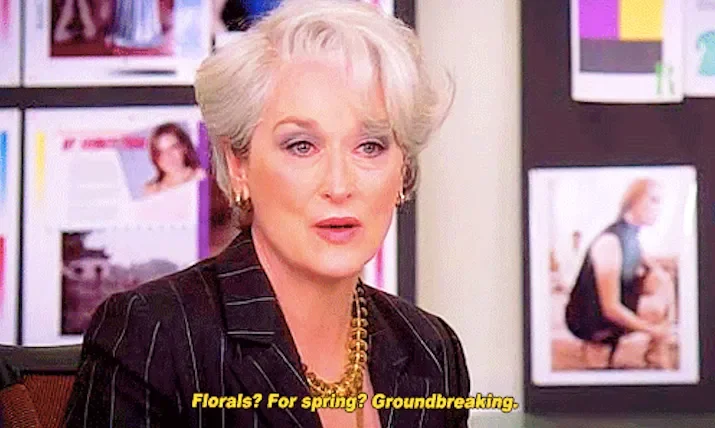
Miranda Priestley - Devil Wears Prada (2006)
What concerns me about the Priestley fanaticism, in conjunction with my own negative workplace experiences, is that we seem to be moving more deeply into the myth that one needs to relinquish their connection to empathy and humanity in order to be successful. In fact, media reflects an intentional conflation of the pursuit of greatness with being a giant asshole. I concede that the magic of movies like Whiplash and Marty Supreme is derived from raising those questions, and playing in the ambiguity - but I don’t trust popular culture to interpret them with the nuance they require. To be clear, there’s nothing wrong with taking pride in your work, and committing to a craft - it shows resilience, commitment, grit. However, there is a marked difference between the desire to succeed and the impulse to destroy everything and everyone that you perceive to be in your path to achieve it. In fact, disappointingly, there is ample evidence of our societal inclination to evangelise real life figures that thrive in that ‘moral grey area,’ insisting that it’s nothing more than the eccentricities of genius (see Musk, Jobs, Karp, Bankman Fried - before his downfall - and many more).
In deifying these amoral figures, we continue to endorse the fantasy that we need to sacrifice - arguably the most sacred and human - parts of ourselves to experience success. Not to speak those dreaded words, but this myth is propagating the collective AI psychosis in which tech CEOs, LinkedIn thought leaders and commencement speakers are obviously mired. Explicitly, AI is attractive precisely because its not ‘weighed down by the limitations’ of humanity.
I see the over-reliance and investment in AI at the expense of people as a symptom, not a cause. For decades, we’ve constructed an environment that values individualistic success and the pursuit of unchecked power over all else - including basic social principles of respect, care and reciprocity. In consistently excusing and even endorsing bad behaviour, the vicious cycle continues, and we’ve all become less human in our professional interactions. I see it in mass layoffs, hiring managers routinely appropriating the work of candidates ‘take home’ assignments, senior colleagues bullying juniors - you name it.
The most frustrating part of this conundrum is that it so unimaginatively conforms to the pattern permeating our society today, yet we still refuse to acknowledge it. Namely, create an atmosphere with extremely specific conditions, and then act surprised by the types of people that it produces. At large, there is the enduring narrative that Gen Z are lazy, undisciplined, entitled. More specifically, as it pertains to modern feminism in the wake of the girlboss era, we’ll jump to ridicule Grede and Neeleman alike but offer no meaningful critique of how we’ve sought, or failed, to correct inter-generational sexism. Unsurprisingly, it’s easier to tear down an individual than an institution. This is not to shift the onus of making change onto the individual either, but rather to remind us where to direct our anger.
In the meantime, lets stop mistaking a lack of humanity and empathy as an indication of greatness. If you’re willing to compromise everything and everyone in your life to pursue a goal, you may not actually be a legend-in-the-making, you might just be an asshole with no integrity.
mental illness is ass, guys.
It’s a sincere tragedy that the sector has such a talent for transforming the most motivated, intelligent, hopeful young people into the most bitter and jaded. However, that’s another story for another time.
and they say women are emotional…
This point was taken from an article I cannot find ANYWHERE! If anyone recognises it, please lmk and I will atrtibute it correctly
Yes, this did actually happen to me.
The rise and dissection of these archetypes is much more engagingly explored through Yesteryear, by Caro Claire Burke.