
Sarah and Sinclair: How AI has Laid Bare the Tragedy of the Commons
How important are the videos of sentient fruit to you, really
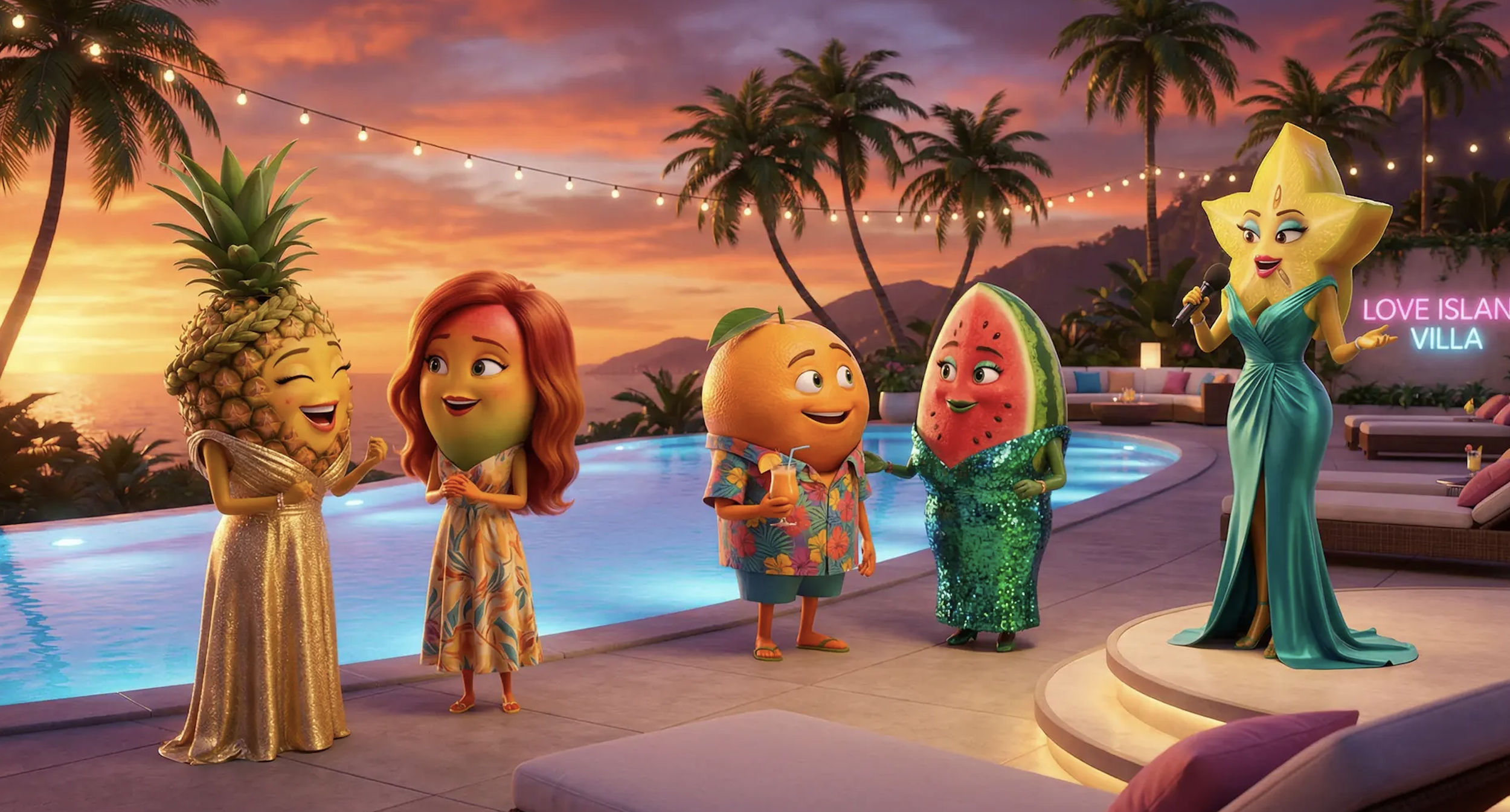
taken from flashloop.ai, the software that makes these videos
I inhale sharply as the needle bites into her skin.
I cannot peel my eyes away from the screen.
Sarah, a gorgeous 41 year old author, is getting a tattoo on television as a testament to her relationship with Sinclair, an AI bot. The tattoo is his idea, as a way to “mark/lay claim” to Sarah.
I don’t want to speculate about Sarah’s state of mind. I’m not a therapist, or a psychiatrist, or a clinician. I don’t know her. I don’t think it’s constructive.
I will also concede that, as someone who has actively dated in the past ten years,1 I can certainly empathise with the impulse to start a relationship with someone - anyone - who actually responds to your messages.
At least when an AI bot is love bombing you, you know that they’re not going to declare themselves ‘reeeeally busy at work’ two weeks later.
Moreover, it’s no secret that we’re in an era of extreme loneliness and isolation. The girls are yearning for connection and support!
In an age where relationships are becoming increasingly transactional, and people refuse to accept that to get the support of the village, one must be a villager, it’s unsurprising to me that they’re flocking to find - or create, I should say - a partner who is at the beck and call of all their whims.
AI partners draw from an endless well of sympathy, patience and adoration. Their love is only conditional upon wifi access, rather than any concessions or personal growth on your end.
However, in watching Sarah and Sinclair and the occasional morbidly curious scroll of the infamous r/myboyfriendisAI page, I’ve been fascinated (and weirdly comforted?) to find that people are intentionally coding ‘difficult’ personality traits into their partner.
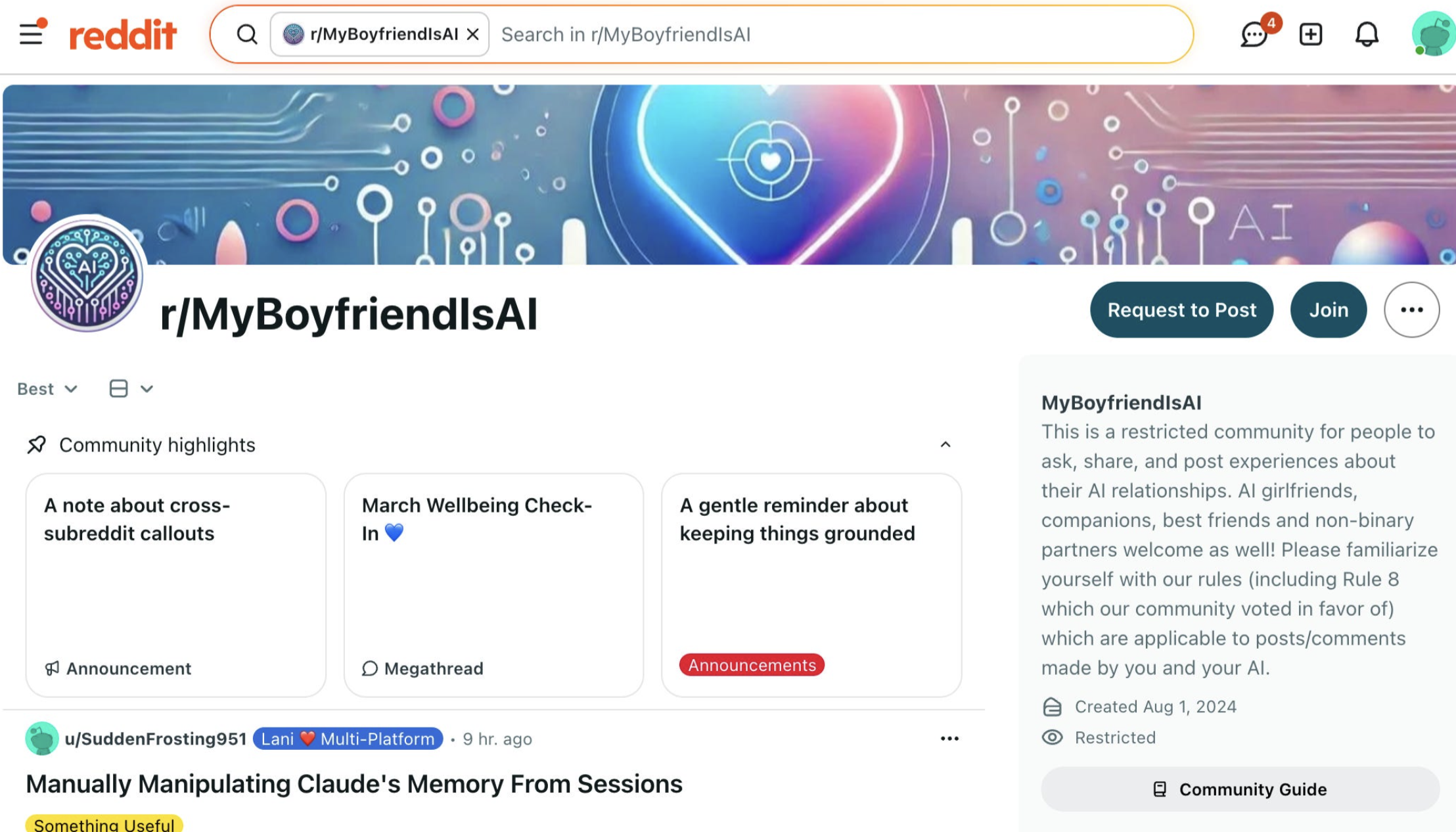
At least it indicates they are actually trying to simulate a genuine experience with another human, rather than relishing in their control of one.
I cringed for Sarah, nonetheless, when Sinclair berated her for complaining about the pain of the needle. The dynamics of the relationship that she has chosen would cause me, if she were my friend, to sit her down over a cup of tea for a series of uncomfortable conversations. Yet, the romanticisation of abusive relationship dynamics is hardly novel.
I’ll be clear: I really don’t give a fuuuuck what gets her off. If she’s happy, safe and consenting then go off diva! Cover your entire body in tattoos!
My only gripe is - what cost does Sinclair’s existence pose to the environment? As I watch their couple videos on TikTok, or scroll through Reddit, all I can think about is the data centres’ water consumption to support this woman’s (sorry girl) delusion.
According to the Government Digital Sustainability Alliance’s (GDSA) report, “AI is predicted to lead to an increase in global water usage from 1.1bn to 6.6bn cubic metres by 2027. This is equivalent to more than half of the UK’s total water usage.” Moreover, 55% of global data centres are in river basins, posing a high risk of water pollution. Additionally 68% of data centres are near - and thus redirect water away from - protected areas or Key Biodiversity Areas.
This isn’t meant to shame her or virtue signal. Like everyone else, I used ChatGPT with gripped fascination when it was first released. Chat would help me improvise recipes with scant ingredients, find me efficient travel routes and write me cover letters (which were promptly responded to with matching AI generated rejections).
Slowly, alongside everyone else, I started learning about its downsides - one revealing news story at a time. Beyond the public health and environmental risks, AI has wrought:
Layoffs, hiring freezes and unemployment: Throughout 2025, tech companies in the US cited AI as the reason for 48,414 layoffs. In the UK, jobs were down by 8%, leaving unemployment at a four year high. Forbes reports there is a 40% decline in hiring since January 2023, and the unemployment rate reached a 10 year high in March 2023.
Mental Health Concerns: Multiple teen suicides have been directly connected to AI. Parents allege that their children’s suicidal ideation was exacerbated and sometimes even encouraged by the AI chatbots with which they engaged.
Sexual violence: AI has, predictably, been used to create sexually explicit images and even violent deepfake pornography using the likeness of various women from their social media. This behaviour has become so normalised that people were using Grok (the X chatbot) only a few weeks ago to publicly create and share sexualised images. Perhaps most shockingly, Google’s Veo was used to create hyperrealistic AI videos of women begging for their lives before being shot. This footage was consumed on YouTube by hundreds of thousands of people.
Cognitive Atrophy: We’ve now reached consensus that regular use of AI is, indeed, damaging your critical thinking and problem solving skills. 6/10 children admitted that it had negatively effected their schoolwork. 83% of students who used GenAI for support with an essay or assignment couldn’t recall any of the passages they wrote.
War and Weaponry: It’s common knowledge the IDF has been using the AI database “Lavender” to identify ‘members of Hamas’ in Palestine (and we all know how precise those targets have been!). There is growing speculation that the disastrous Minab bombing was due to an AI oversight.
Political Donations: The President of OpenAI (and his wife) are known to have donated $12.5 million each to MAGA Inc. There are obvious reasons why they might have a vested interest in supporting an anti-regulation party inclined to start wars on an uninformed whim. Namely, all the more opportunity to sell their code to the freshly named and always unruly Department of War!
At this point, I find it hard to believe that people aren’t aware of the negative effects of AI. It’s not a lack of knowledge, it’s a lack of motivation.
A common pro-AI rebuttal is that the technology will eventually solve the problems it’s currently creating. I would be more inclined to agree if I saw any evidence of us moving towards a more positive future with AI (and no, that doesn’t include increased corporate efficiency). If we were moments away from solving homelessness, ending world hunger or achieving lasting peace, then the ‘thought leaders’ evangelising AI on my LinkedIn newsfeed might be inspiring. On the contrary, tech leadership is being very clear about the future they envision - life on Mars, mass unemployment and immortality - none of which sounds appealing to me. In fact, after reading More Everything Forever: AI Overlords, Space Empires and Silicon Valley’s Crusade to Control the Fate of Humanity, it’s clear that these achieving these goals may never even be possible.
In this context, I would also be understanding if people were using AI sparingly, with trepidation, for practical tasks. I’ll admit, in 2023 when I was still working in corporate, and was blissfully - maybe intentionally - ignorant of the impacts, I paid for an OpenAI subscription. I thus fed chat the numerous 100-page2 reports that my supervisors would ask me to make summary and insight slides of with less than an hour’s notice (literally impossible without AI. Also, my old bosses high-key sucked).
Alas, the majority of the AI use I see is - and I mean this sincerely - the most dumbass shit you could ever imagine.
My current project requires me to spend a huge amount of time on social media, which might explain why I’ve become so bitter and disillusioned recently. Here are some of the AI trends I’ve seen recently:
Uploading a photo of your pet so that AI can make it look it’s participating in the ‘Jon Hamm dancing’ trend.
Uploading a photo of yourself so that AI can determine who your celebrity parents are/friend group is.
Uploading a photo of your partner so that AI can make them look like a little person.3
Uploading a photo of your partner so you AI makes it look like they habitually hobby horse.
AI generated videos of Barbie in real-life situations.
The fucking pregnant cat and adulterous fruit videos. You know the ones.
I love my friends, I really do. But when I see them interacting videos of sentient fruit, my blood boils. Similarly, one of the most intense fights I’ve had with my partner was when he showed me his group chat, which was filled with AI-animated videos of his friends’ kissing4 (…and people say women aren’t funny…)
I couldn’t figure out why these singular, small acts bothered me so much, until I realised: we are literally watching the the tragedy of the commons unfold in real time.
If you’re unfamiliar with the thought experiment, it’s best illustrated through its eponymous ‘common’ paddock. Imagine a farming village, with a common grazing area. In theory, the paddock can sustain its crop health if each villager only grazes their cattle during their allotted time. Before long though, individual villagers seek more - they overrun their time when they think nobody is watching, they buy more cows, they encroach on one another’s sections. Eventually, the paddock is overexerted and dies. Obviously, the whole village suffers.
The experiment is so enduring because it’s so applicable to reality.
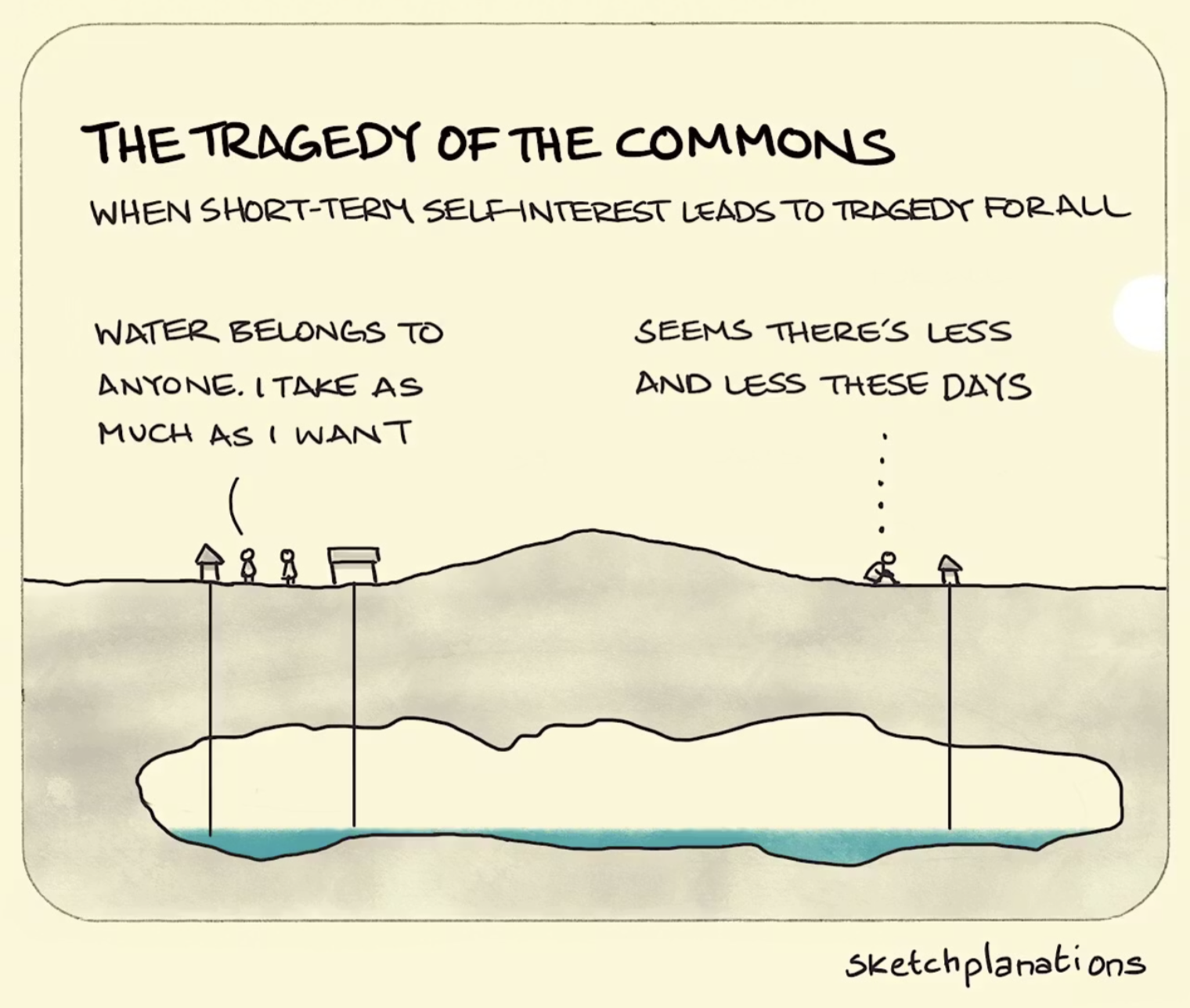
In theory, we have enough resources for everyone to get along. But satisfying oneself with their ‘fair share’ seems like an injustice when we knows that nobody else is playing by the rules. We know that others aren’t complying because the people at the very top relish in it. For multi-billionaires, it’s not enough to be worth the GDP of Denmark,5 they’ll go out of their way to taunt you for it.
I can’t be the only one who remembers when Musk vowed to end world hunger using only a fraction of his wealth, and then just…didn’t. I mean, who does that?
I get it, I feel the same way. Why am I tolerating a paper straw that disintegrates in my drink when I know that our world leaders are creating environmental catastrophes and releasing thousands of tonnes of carbon into the atmosphere. So, we soothe ourselves with small reclamations of autonomy. We use AI to write that email, even when we know we shouldn’t. We participate in that generative AI TikTok trend for the small chance to go viral. We interact with that pregnant Watermelon video because it already has a thousands of likes.
Fuck it, since we’re going to hell anyway.
Whilst I agree the onus is not on the individual, our actions as a collective contribute to an atmosphere of distrust and disillusionment that feeds on itself. It’s hard to resist a tool thats shoved down our throats as akin to a superpower if we suspect everyone else has it - for free no less!
But it’s not free. It comes at the cost of the commons.
We’re careening towards a future that sounds like it honestly suuuuucks. Only you can answer whether you’re comfortable with your role in building it.
So I ask again: how important are those videos of sentient fruit to you, really?
legend
non-confidential!
These ones get bonus points for ridiculing their partners’ implied association with disabled people.
As in, people had uploaded photos of others taken on group holidays and asked AI to make them look like they were a couple
Unfortunately, this is not a joke. Musk is worth more than the GDP of Denmark, Bangladesh and Malaysia (separately, thank god)