
Loi du mort-kilomètre: war reporting in the US and UK
Numb is in! But lets leave a little room for shame, yeah?

Rachel Sennott at the 97th Academy Awards (March 2025)
There is one thing I miss above all else in formal education.
It’s that moment where something just clicks. It can be anything - a theory, fact or opinion that re-contextualises a problem I hadn’t been able to name before. It gives me the language and permission to see the world in a different way, understand interactions between forces I didn’t even realise were connected. I can almost feel a new synapse forming. The clarity it brings is an eye-rolling, spine-tingling relief. The veil falls and there is a shift, an instant reconceptualisation of the world as I understand it. It re-engages and re-energises me. I’m once more filled with a curiosity and appetite for life that I hadn’t realised was slipping away….
…if you can’t tell, I am both an extreme depressive and a giant freaking nerd.
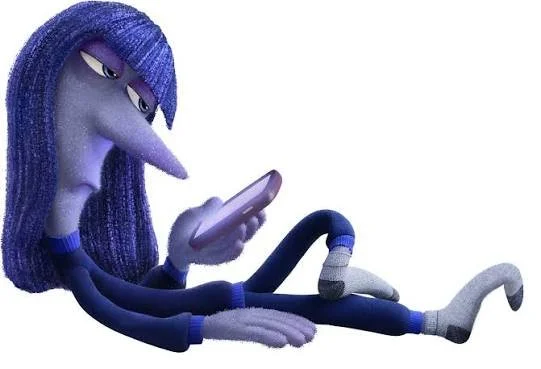
Live footage of me having gone too long without feeling the joy of learning something new (but fr it’s Ennui from Inside Out 2)
Some moments are hard-won, after hours of staring pleadingly at an intractable excerpt, willing the words to magically reorder themselves into something accessible. I have spent more time than I’d like to admit practically begging the academic gods to allow me to understand Bourdieu’s writing first hand, rather than relying on summaries and explanations. These gods are yet to appease me.
Others are instant. I have been glowering in the back of a lecture hall hungry, hungover and heartbroken, half listening to the teacher and still been absolutely floored by a new insight. It’s so obvious when someone spells it out, and yet I’d never before been able to name it, identify it, apply it. I guess I’m not what you might call an original thinker.
One of these moments hit me, surprisingly, on an idle Tuesday during an elective I took at graduate school only tangentially related to my degree.
Explicitly, I was enrolled in the school of international affairs, but the administration also allowed us to take classes at the journalism school. I had spent a few glorious months beforehand as a writer for an online magazine in Cairo. (I don’t like to brag,1 but I have built my entire life around impulsive side-quests.) Unlike my other jobs,2 the team in Cairo was encouraging and interesting and fun. I missed writing more creatively, so I signed up.
The teacher was leading a conversation about rules for pitching to editors, and switched to a slide entitled: loi du mort-kilomètre.3 I can’t think of the right translation in English, neither the proximity principle nor ‘death by the kilometre’ are appropriate. In any case, my jaw went slack.
The ‘law’ posits that humans are much more likely to be emotionally affected - and thus concerned - by a major event nearby than far away (duh).
It’s so simple. It’s so painfully obvious.
Yet, seeing it spelled out somehow interrupted the crushing thought spirals that had consumed me for months.
Let me explain:
My classes at graduate school were mainly examining the legal structures, apparatus and mechanisms ‘upholding’ human rights. To contextualise these laws, the majority of classroom discussions explored the most egregious violations of human rights to explain how they happened or are happening. This overflow of sickening information triggered in me a pathetic indecision over which causes to dedicate myself. Even selecting topics for term papers, presentations and classwork felt like a horrifying moral calculus - how do you choose which issue ‘deserves’ your attention and analysis?4
Eventually, I would find some way of prioritising one case over another. I thought this would bring me relief. Instead, I was introduced to an equally hideous cycle of repulsion and guilt for having deemed one violation more ‘worthy’ than another of my research and attention.
In short, I would first punish myself for not being ‘smart’ enough to remain academically objective, and then punish myself for finding the capacity to evaluate and compare unrelated violations.
It was fucking exhausting.
Loi du mort-kilomètre gave me an insight into my own brain. It felt like a cheat code to understand the unconscious logic that ruled my ability to access sympathy. It’s natural (not admirable, though) to feel more moved by one story than another.
It’s literally just proximity.
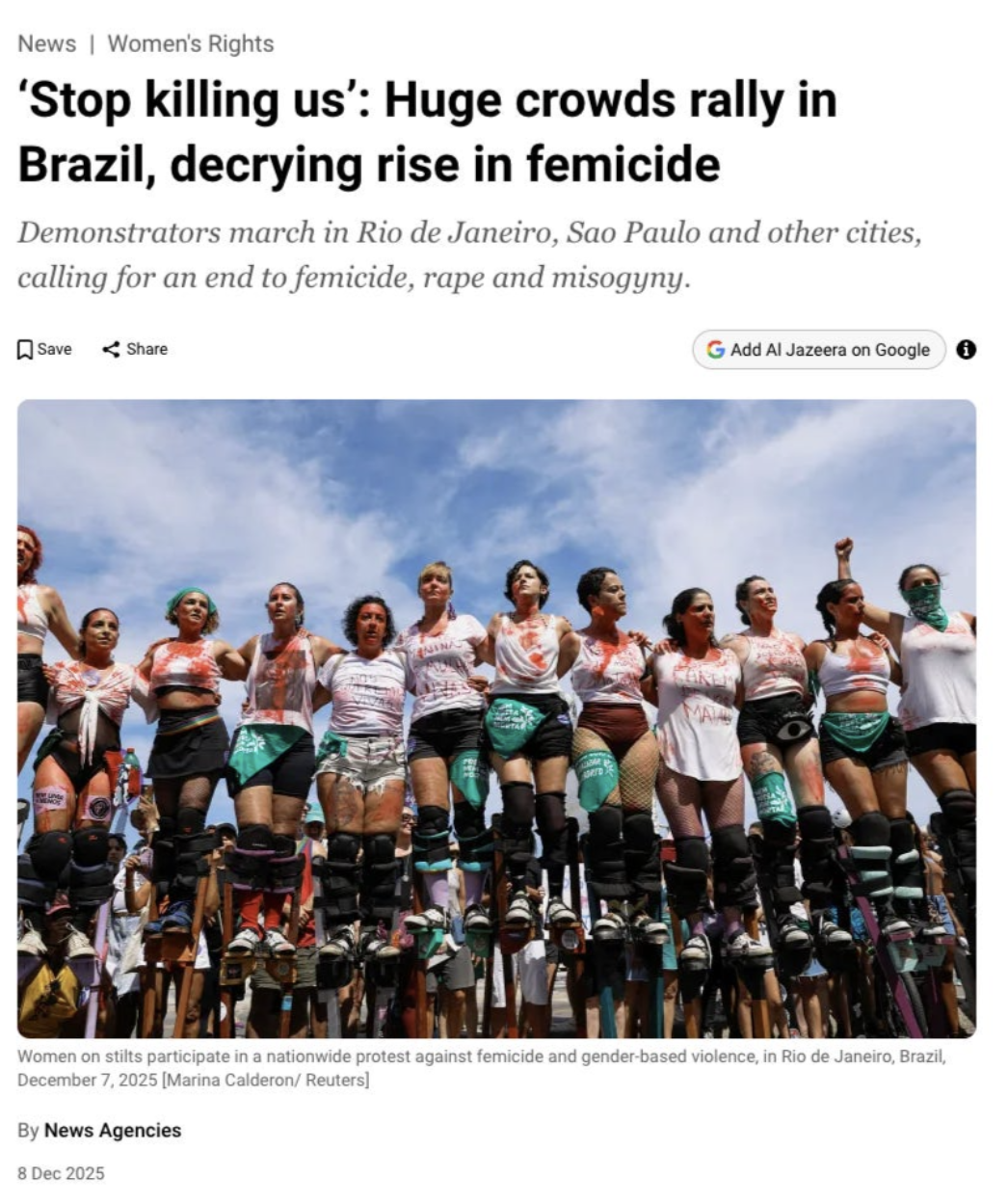
As a women, for example, I’ve always been affected by the movements against femicide and GBV across the globe. (Al Jazeera, 2025)
This proximity does not have to be geographical. As social beings, humans are hard-wired to seek, build and protect perceived community. This ‘community’ can be any shared identity e.g. gender, post-code resident, religion, political affiliation etc. - it’s human nature!
Not only did it relieve my self-flagellation, but it also reminded me to give other people a fucking break.
Even now, I often fall foul to the siren call of the sanctimonious ‘whataboutism’ that dominates social media comment sections. It’s not an excuse, but of course people are going to give more grace, sympathy and attention to others that resemble them in some way. This inclination exists even before the additional complex pressure of politicians and the media bestowing the implied title of ‘perfect victimhood,’ on some, and justifying atrocities committed against others. It’s not a personal failing, it’s an evolutionary survival mechanism. My faith in humanity was, if not restored, then at least reassured.
The loi du mort-kilomètre was the grounding principle I returned to in frustrated conversation with anyone hyper-focused on how an issue might effect their community, rather than allowing themselves to see the bigger picture.5 The loi du mort-kilomètre was the mantra I recited to myself as I took deep, slow breaths when some insufferable man started yelling about the ‘male loneliness epidemic’ at the pub, for instance.6
Yet, this has taken on a whole new meaning now that another war has broken out (read: illegally started with no warning in the midst of peace negotiations by a convicted felon and an accused war criminal who are unironically trying to pose themselves as humanity’s collective moral compass).
I’m not sure how many deep breaths I can take here. My patience is running thin.
I can understand why, logically, we want to know how things will effect us and our communities. Therefore, I can understand why an editor might make the difficult decision to publish one angle over another.
But…
I would be the first to say we’ve gone too far.
I have read about and listened to endless coverage of oil prices. In comparison, I’ve seen seemingly one or two informational articles about the death tolls in Iran and Lebanon.
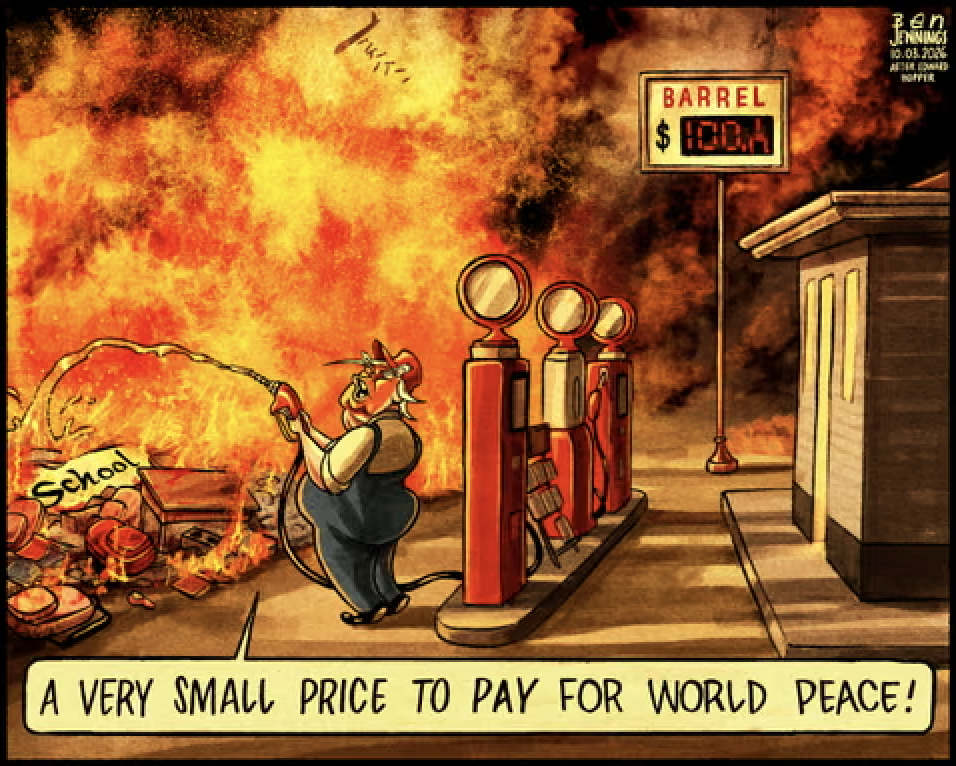
Ben Jennings for The Guardian (9th March 2026)
I understand that oil prices have far reaching implications - there is an affordability crisis and the prospect of not being able to heat your home, get to work or feed your family is very bleak. Nonetheless, it’s difficult to see how the decisions to habitually blow up oil fields and subject civilians to toxic black smoke didn’t receive more than a passing glance in public discourse.
Whatever you think about Iran’s regime or the legitimacy of laws surrounding collective punishment, this is not ok.
Similarly, my newsfeed is flooded with Pete Hegseth and Trump edits. They’re funny, I’ll give you that. But removed from a sincere understanding of the stakes of these speeches, I feel kinda sick.
I was willing to pawn this off as dark humour. Who am I to dictate how we all process and live through the collective tragedy of entitled losers dragging us all into a deadly, unnecessary protracted war without consent?
Yet, my excuses for everyone ran out when I listened to Vox Media’s coverage of Kalchi and Polymarkets betting on the war.
I can’t find a more eloquent way to say this: Get a fucking grip.
The media (both social & traditional) and the public are currently engaged in a vicious cycle of symbiotic delusion. The media - through the discerning use of passive voice and ‘careful’ selection of verbs - has surgically detached the average person from any uncomfortable feelings about the ongoing commission of war crimes and slaughter of civilians by Israel and the US. In turn, we consume these headlines and pretend the worst thing that’s happening is rising utility bills. According to the loi du mort-kilomètre, it doesn’t matter if children are dying on Beirut’s streets or Minab’s elementary schools - won’t somebody just tell us how much the goshddarn electricity bill will rise!?
This is all the more ironic in that, if my social feeds are to be believed, people in the US actually believe they’re liberating the Iranian people. We’re positioning ourselves as the ‘saviours to an oppressed people’ by… bombing the living daylights out of their populous major cities? killing their children? creating a power vacuum to be filled with another man who’s not only thought to be more hardline but is also grieving the recent death of a large portion of his family?
I get it. I don’t want to shoulder the blame for it either, but the myth of American exceptionalism I fell for in the early years of my life, and the tax dollars I pay now7 leave me - at least to some extent - culpable. The people are disaffected - their nerves run so ragged the only thing they can do is sit back and ‘make the best of the situation’ (i.e. try to make money off of it - likely to pay those pesky utility bills!). Moreover, post-irony culture forbids you to betray any sign of earnest emotion. Numb is in. It’s social death to be ‘chalant.’
There has to be a middle ground.
We’ve fucked up. The least we can do is pay enough attention to the consequences of our actions - not just as they relate to us. If you can’t manage that, at least don’t bet on it. Assholes.
I do, actually
shots fired.
I’m not trying to be a dick by writing it in French, I swear. I googled the term in English and all the search results yielded are units of measurement to illustrate how deadly a section of road is.
This also implies an embarrassing level of self-importance that is not lost on me. I am aware that the plight of the Rohingya Muslims - for example - was not going to end or even be remotely effected if I were to choose it as a the topic for my final exam. I’m not insane.
Not to get too human rights-y~ about it but the whole system is predicated on equality. Affording yourself justifications and excuses means that we all lose. It’s not a zero-sum game.
I get it, men are lonely and it’s extremely serious. Mental health and isolation are scourges on our society, but they effect everyone. There is plentiful data that suggests women are just as - if not more - lonely than men, and it irritates me to no end to not see it discussed with the same sincerity, particularly in the broader context of consistently ignoring women’s health issues.
since working freelance, I don’t earn enough money to have to pay taxes whilst living abroad - so good for me, I guess?!