
A Rejected Essay for Modern Love
someone needs to hear it, i guess?
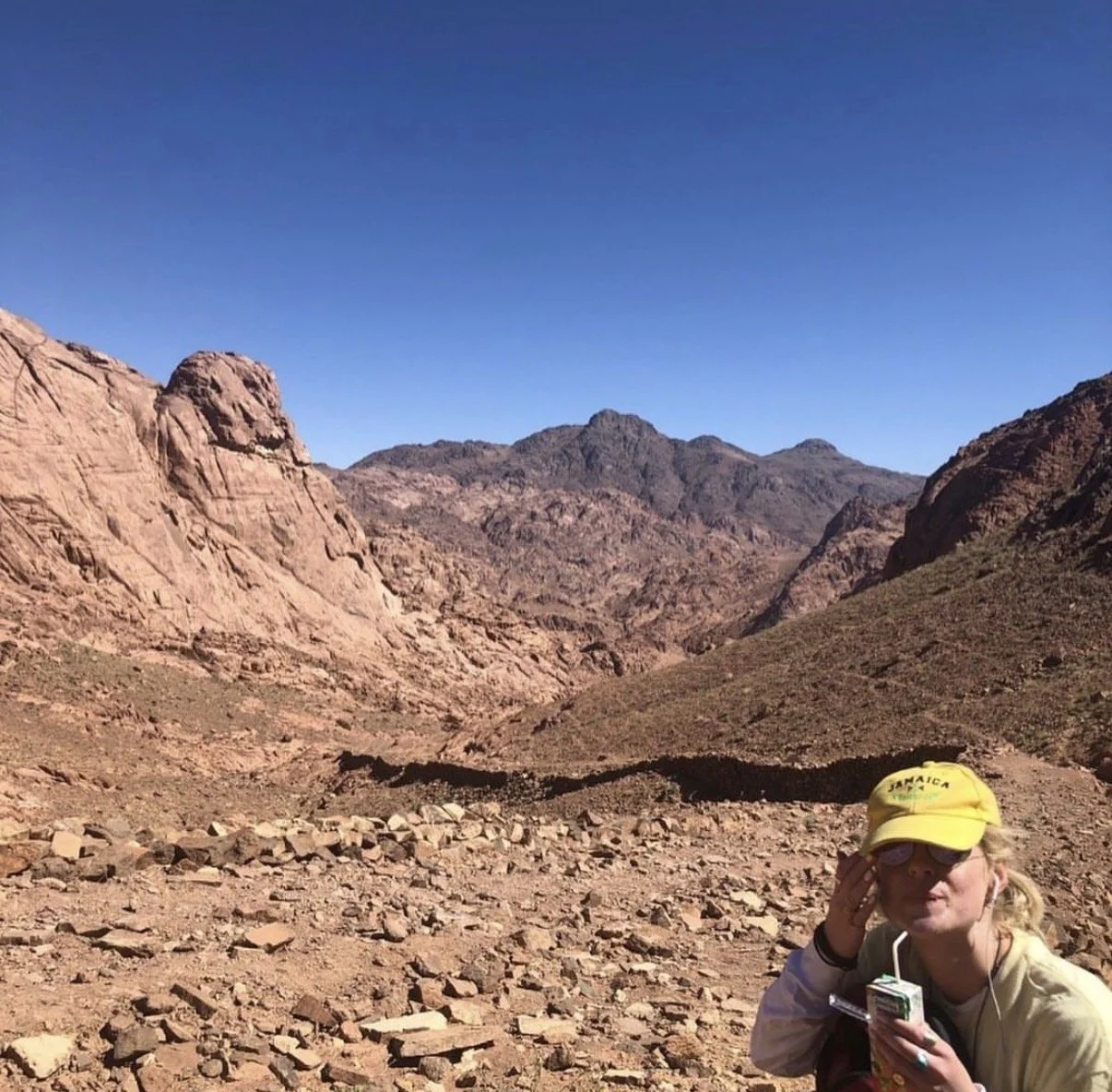
Hiking in the Sinai (2021)
I’ve never really considered myself a private person.
In fact, I frequently find myself acting on the irritating impulse of oversharing - mostly at dinner parties. I suppose that I always secretly hoped it was endearing, but I know from watching others do the same that it’s mostly just uncomfortable.
Yet, when several of my friends - on entirely separate occasions - asked if they could add me to ‘Find my Friends’ so that we could access each other’s locations at all times, I was speechless.
“Obviously not!” I protested “Why would you need to know where I am all the time?”
They all only shrugged in response. I still refused.
One friend, knowing my passcode, went so far as to accept a tracking invitation from my phone. This behavior had become so normalized that apparently it didn’t occur to her that it might bother me.
This behavior seemed symptomatic of a much larger culture of having to know everything about everyone. This expectation was perhaps facilitated both by social media and the limited social life that a campus-bound college entails. It’s only in hindsight that I’ve found it troublesome that I ever felt equipped, let alone entitled, to comment on the intimate details of a relationship shared by two loose acquaintances at any time. In turn, according to the rules of a brutal exchange that I seemed to have tacitly consented to by my existence within these circles, others seemed to have felt the same way about mine.
At the beginning of my junior year, just when I had fooled myself into thinking I had grown older, and wiser, my college boyfriend, with whom I was madly infatuated, abruptly ended our relationship one late summer evening on the steps of St. John the Divine Cathedral on West 113th Street. This was a landmark I resentfully strode past almost every day during the months following on the way to my best friend’s apartment where I would chain smoke and tearfully re-hash the details of what, exactly, had gone wrong. The heartbreak, obviously, was bad enough. But the pain was relived every time I ventured into a college bar. I would be approached by some sleazy guy, or some gossip-thirsty girl veiling her ulterior motives with fictitious concern or feigned ignorance.
These encounters made me feel like my relationships were never really mine - they existed as dramatic entertainment for the casual observer rather than for the fulfilment of those involved. This nasty belief seemed to re-affirm itself every time someone intervened during the months following my - apparently - amicable break-up. These interventions were either cruel and public - like being disinvited from events, or they were quiet words whispered to me by my close friends. For instance, when I first ran into my ex at a warehouse in Brooklyn - another friend thankfully interrupted our faltering conversation to pull me away from the groups we had respectively arrived with. As soon as we were out of sight, she grabbed my face to focus my vision - fast blurring with tears - and sternly said: “I love you, but you have got to get your shit together. Nobody can see you like this.”
But, why couldn’t they? Why was I fiercely defending my pride - as though it would be irreparably damaged if I was seen to be upset by an experience that is universally acknowledged as one of life’s most acutely painful rites of passage? Why was she suggesting our audience was so intent on spotting signs of pain, hurt, weakness even?
I would be lying if I said I had been mature enough to come to this realization there and then. Instead, I bought a drink that I didn’t need to account for my absence, and marched past him to rejoin the crowded dancefloor.
This is the kind of attitude towards dating I had adopted. I too was engaged in this false competition to showcase my apathy and disengagement towards the people I cared about. I was determined to never get too attached, so that once it was over I could easily shield my embarrassment in the public arena - defending my pride on the basis of shaky claims that I had never really cared to begin with.
It was with this mindset that I moved to Cairo post-graduation, and I met him.
I had accepted a vague invitation to go to a pool party on someone’s farm outside of the city. Apparently, that was all the prompting I needed to uber to a random location that this mysterious host had pinned for us on google maps. As our driver slowed the car on a road that I can only describe as, quite literally, the middle of nowhere - I’m talking real life tumbleweed - my heart quickened. It was through my, perhaps irresponsible, tendency to accept invitations like these that my roommate and I had - ironically - agreed to track each other’s locations on Find my Friends the night before. I breathed a small sigh of relief when I remembered this, and a much bigger one when I spotted a silhouette a little further up the road manically waving his arms and howling with laughter at how pathetically lost we looked. Beyond my overwhelming relief, all I could think was: “Christ, that man is enormous.”
As he welcomed us into his home, I watched this enormous man move with surprising grace around his kitchen to make us all coffee and breakfast. Even though we were strangers - and apparently two hours early, he showed no sign of irritation. Instead, he made easy conversation with each of us, pausing only to validate even the weakest of jokes with roaring laughter.
Of all the crushes I’ve had in the past - they have nothing in common except for an uncanny ability to command the attention of the room with a sparkling charisma, and put people at ease with their charm and kindness. Predictably then, within minutes, I felt a familiar flutter in my belly - and a smile begin to tug at the edges of my mouth.
Crap, I thought. I’m in trouble.
It was only after he had handed me a Turkish coffee in a glass that was dangerously close to overflowing, and feeling it would be rude to ask for another - I, in my infinite grace, intuitively picked up a teaspoon and tried to drink it like a soup, blowing on it to cool it down. I looked up to see him staring at me with disbelief and amusement. He decisively declared “That is the most foreign thing I’ve ever seen.” I blushed a deep crimson, and tried to play it off. But it was the way he said it - with such kindness and affection, devoid of judgement, that made my stomach twist and my breath quicken.
Crap, I thought. I’m definitely in trouble.
He eventually picked up on the numerous hints I dropped and asked me out. I felt compelled to explain the precariousness of my place in Egypt, he understood. For the remaining weeks, we fell into a routine of what I imagined grown-up couples might do - without the weight or pressure of expectation. He would pick me up from Arabic classes to go to dinner. Usually, I would jump in the car in the midst of a phone conversation with my parents - whenever it got particularly heated, I felt the steady weight of his hand on my knee in support. Some weekends, he picked me up from just outside of Cairo and we would drive the remaining distance to the farm where we first met. He helped me with my Arabic homework, nudging me toward the correct answer in a lighthearted, teasing way that - astoundingly - didn’t dent my fragile ego. We went to the desert one weekend and camped there, spending the evening chatting, drinking by a bonfire and staring at the stars. When I got sick, he drove an hour and a half just to bring me flu medicine and food, which I ungratefully and childishly refused to eat because the name translated in English to the unappetizing “birds tongue soup.” When we received notice that I was leaving - possibly for good - he didn’t withdraw his support. Instead, he organized a weekend trip away for us to be together, and took a few days off work to help me pack up my apartment, take me to the desert for a final picnic, and drive me to the airport.
I don’t think this was a great love, and I know he would agree. But I do feel as though I learned from it.
I didn’t know anyone in Egypt, and I was relieved by the specific freedoms that anonymity provides. My old friends were never able to comment on his penchant for crocs, or the fact that he panicked on the first date and took me to - I kid you not - a parking lot to share a bottle of wine. I, in turn, never felt like I was playing to an audience. I never pretended that I didn’t care. I was unencumbered by the burden of feigning apathy and detachment to protect the credibility of my future self as I, in some bizarre Egyptian equivalent, nonchalantly tried to ignore him in a warehouse in Brooklyn. I had no trouble asking for what I wanted and expressing hurt or dissatisfaction if I didn’t get it. We were free to negotiate our relationship, our dynamic, and how we defined it on our own terms.
I am aware of the irony of expressing an enduring revulsion for publicity in my relationships - to then broadcast the details of my first - genuinely private - encounter on an incredibly public platform. To that, I have two responses. The first is that in this instance, I am able to control the narrative. I may choose to speak of it in any way that I wish - and it was this control I was craving. The second is that - of course, I haven’t told you everything. There are some parts that are just for me.